As Peter Thiel argues, if the academic world and the heterodox world (which my book is a part of) “came into contact,” then “they wouldn’t both be able to exist.” This is exactly how it is. Jacob Hamburger is a graduate student at the Ecole Normale Supérieure in Paris, whose work has focused on Cold War liberalism and neoconservatism in France and the United States. His journalistic writings have appeared in numerous publications in both English and French; and he has translated the authors Michel Foucault and Marcel Gauchet. Jacob covers American politics for the satirical weekly Charlie Hebdo, with which he recently co-created a special report on the left under Trump entitled Feeling the Burn. He is also the editor of Tocqueville 21, a blog devoted to democratic politics and ideas in the 21st century.
About This Article
- Springer Nature or its licensor (e.g. a society or other partner) holds exclusive rights to this article under a publishing agreement with the author(s) or other rightsholder(s); author self-archiving of the accepted manuscript version of this article is solely governed by the terms of such publishing agreement and applicable law.
- Kisin cites the increasingly poor quality of public debate as evidence that he was mistaken in the core “anti-woke” contention that open debate always tends toward truth.
- Once elected to Congress, Tea Party Republicans like Ted Cruz and others proceeded to shut down the federal government rather than attempt to reform it.
- He has been criticised for making these choices based on identity rather than merit.
- “Perhaps there is nothing more dangerous for the Woke left than the criticisms made by other Progressives—rather than taking these criticisms seriously, these other Progressives must be nullified by being branded ‘Alt-Right’ or ‘Conservative’,” he writes.
- For instance, higher social standing and confidence are linked to elevated use of “you” words and reduced use of “me” words.
But in the case of the IDW, I’m going to argue that it was unable to offer a solution and, in fact, unable to even arrive at the necessity of a solution itself. I think even a lot of the people—and I’ve talked about this with some of them—would say that the IDW has scattered, people have gone in different directions, and it’s not a coherent intellectual force as it once was. And if you look at it, there are a couple of reasons why this happened, but it starts with the sequence of events over the last few years since this group rose to prominence.
Part of the search for truth should be a search for what could be called political moral truth, simply the way to say something that is both true and helpful. The process of arriving at such a stance can be incredibly murky and dangerous. Even the haunting reminders of genocides and slavery do very little to deter the quiet doubts about any commonly parroted false narrative. Our curiosity and the voracious hunt for true explanations can not be leashed by the horrors of our past forever.
If That’s The Case, Then What Does It Stand As An Alternative To?
A common refrain on the dark web is to debunk various left-of-center critiques by arguing that what appears to be systemic inequality is actually the result of individual choices or behavior. In either case, the dark web’s impulse when confronted with claims of inequality is almost always to deny or justify it. Either the left is making up injustices where they do not exist, the argument goes, or they disregard evidence that social disparities are in fact grounded in scientific reality. In the 1990s, left and progressive thinkers including Richard Rorty, Cornel West, and Edward Said made clear their reservations about certain activist tactics, and articulated positions in line with the same universalist values neoconservatives claimed as their own. Today, magazines like Current Affairs dedicate much of their content to debunking the claims of dark web figures while also addressing the limited effectiveness of “social justice warrior” politics. Treating the beliefs of the dark web as politically conservative views, rather than a sort of transpolitical meta-position — that is to say one critique of political correctness among others, albeit an extreme one — could do much to bring these sorts of left alternatives into the public debate.
Why The IDW Fell Apart
But this only leads one to wonder whether membership is by invitation, request, or if the movement merely pulls public figures into its orbit like some trending black hole. Pinker has shared the stage with several IDW members but has never proclaimed himself a card-carrying member. Economist Glenn Loury and linguist John McWhorter aren’t mentioned in the article or on the website, but others have claimed they represent the “black wing” of the IDW. Complaints about a stifling and censorious climate of political correctness are also far from a novel development. Nonetheless, as Brooks argues, the so-called IDW still represents something more than just garden-variety cultural conservatism even if the two share plenty of terrain. The fascist movement in the Republican party has turned to critical race theory instead.
A Higher Thing Than History
It’s a shocking statement that really could be quite dangerous when it comes to safety measures and policy decisions. It diminishes the behavior fueling power of something like “belief.” But it also may not be as absurd as its first impression gives. I am conceiving “a belief” as a kind of internal narrative which has risen to the point of unquestioned personal allegiance. At some point along its ascent to that level it has forgotten its initial practical purpose of psychological coddling from a cold reality. It becomes nearly impervious to empirical investigation and entrenches itself atop a kind of identity crafting armor. So, when one takes a hard honest look around at existence and notices a morally chaotic deterministic universe where death is real, putting a “God in heaven” filter on that mirror is pretty understandable in order to avoid the “true” view.

The Intellectual Dark Web: A History (and Possible Future) Paperback – March 17, 2025
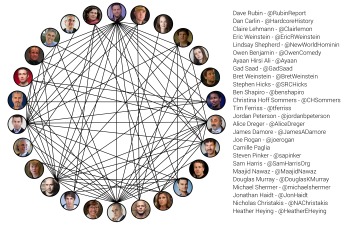
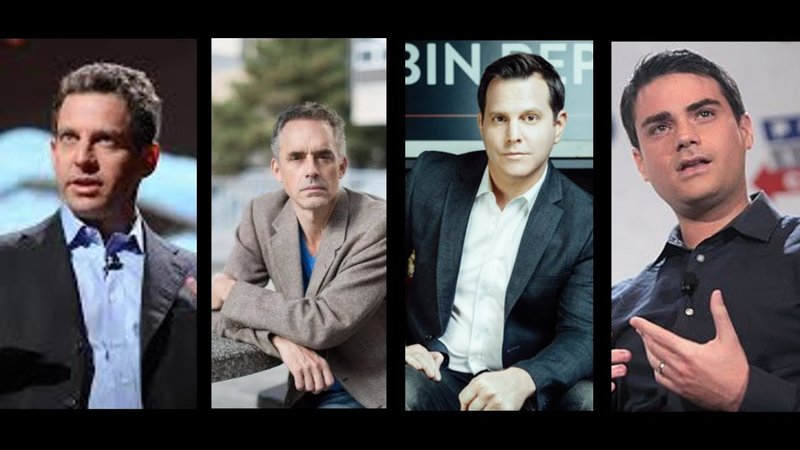
What exactly are the ideas that have made people like Weinstein, Sam Harris, Jordan Peterson, Joe Rogan, Dave Rubin, Ben Shapiro, and Christina Hoff Sommers into what a recent New York Times profile described as intellectual “renegades”? According to the Times writer Bari Weiss, most emphasize the biological differences between men and women, a feeling that free speech is “under siege,” and a fear that “identity politics” is a threat to the United States’s social fabric. They use YouTube and podcasts to criticize political correctness and what they call “the regressive left” meaning extremes in left-wing politics.
Arthur Schlesinger, for example, feared that multiculturalism might weaken America’s vital center (although he also acknowledged the cultural threat from the right). Structural arguments about the oppression of black people and women didn’t often make it into mainstream publications. The Intellectual Dark Web exists because many still venerate objective truth.
The ‘Showing Brainrot To Strangers’ Trend Erupts Online
Challenging restrictive intellectual and cultural orthodoxies, this group advocated for free speech and individual liberty. This book examines the IDW’s history, philosophy, and impact, covering figures like Jordan Peterson, Sam Harris, and Elon Musk. It analyzes the group’s concerns, including political correctness, identity politics, and the state of universities and media.
White Noise, White Heat, White Books
Liu Zhongjing, arguably, is the forefather of the Chinese intellectual dark web, and currently its most notorious stalwart. “I was told that there had been complaints; however, despite asking, I was never told who complained nor the nature of the complaints,” continued Roberts. “The book was then investigated and it was determined that it could not return to sales in its current form.”
What Was The Intellectual Dark Web?
But writers who suggest that black people are relatively more likely to be stupid are likely to have a much rougher time of it than in the 1990s or the aughts. The same is true for men who call for women who have had abortions to be hanged by the neck until dead. Leon Wieseltier, who ran the New Republic’s book section as an independent barony, sought to exercise a droit du seigneur over female employees, as we learned last year. Slate, famous for its contrarian #slatepitch pieces, published several essays by William Saletan on race and research, which credulously accepted the arguments of J. Philippe Rushton, a race-obsessed researcher linked to the racialist Pioneer Fund and white nationalist New Century Foundation. We can’t search for truth through any other principle because that means we would have to afford special protections to those claiming offense.
- Even as Buckley advocated for authoritarian policies such as racial segregation, invasions of foreign countries that were insufficiently capitalist, and criminalizing abortion and birth control, he portrayed himself as a sybaritic harpsichord player who spoke with Transatlantic accent.
- Given how influential this group is becoming, I can’t be alone in hoping the I.D.W. finds a way to eschew the cranks, grifters and bigots and sticks to the truth-seeking.
- “The real Trump derangement syndrome was not to have seen how appalling and dangerous and deranging it was to have a person like this get anywhere near the Oval Office,” Harris added.
- These thinkers ought not to be allowed to pretend that its ideas are, historically speaking, anything other than conservative.
- LIWC is used in research to analyze the ways people use words when communicating, which can provide rich information about their beliefs, fears, thinking patterns, social relationships, and personalities.
- His one concession to a more pluralistic society, a 2007 immigration reform bill, was shot down easily by the party’s far-right flank.
Since then, Peterson’s abrasive advice and abstruse theorizing in the realms of psychology, evolution, ethics, religion and myth have attracted huge swaths of followers. His constant railing against political correctness has made him a particular favorite of disaffected young men who might otherwise gravitate toward (or already are dabbling in) the alt-right. If you listen to Peterson for more than five minutes, you’ll see that he hates right-wing identity politics as much as the left-wing variety. But his demeanor can make him come across as a blunter instrument than he actually is, and he seems to enjoy the limelight too much to refine his message or change his tone.
For that hope to be realized, we have to remember that there are lots of birds in the nest, not just one crowing rooster. This, says Brooks, means going beyond both traditional social democracy and the sometimes well-intentioned but ultimately wrongheaded culturalist politics still found throughout much of the contemporary left, without slipping into crass economic reductionism. Here, drawing on the internationalist perspective that will be familiar to regular viewers of his YouTube show, the author cites a number of potential inspirations ranging from the 1955 Freedom Charter of the African National Congress to the writings of Cornel West and the Bengali Marxist M. N. Roy. The IDW is a nexus of commentators that emerged in the 2010s to challenge the solidifying “woke” consensus on topics such as gender and academic freedom. Usually emphasising rationality, open debate and free speech, this caucus sought to defend the classical liberal worldview in an increasingly censorious and “post-truth” climate. But this typically did not include much consideration of the enabling terms of thought or discussion itself — least of all, of the media within which these take place.
As soon as we do that, we elect authorities who decide what is offensive and what isn’t, and that is where the danger lies. How many times have we seen professors, student groups, and individuals punished for perceived offense determined by institutional authorities? Protecting the downtrodden might be considered a virtue, but overprotection is a vice. We are selectively choosing which arguments are ok to make by a cabal of politically correct youth, who claim to stand for the oppressed. The world of truth is too dangerous for these vulnerable persons, so we must bubble wrap knowledge as to not harm their sensibilities, so the logic goes. Well, in bubble wrapping the world, we disguise its reality, and that is a surefire way to cause catastrophe.
But only one cheer, because he’s still letting some mortifying IDWers off the hook for behavior he’s decried in others, and he hasn’t yet truly reflected on why he was so taken in by dim careerists and a movement built more on emotional opposition to wokeness than a noble pursuit of truth and vigorous debate. It’s frustrating (and sometimes even embarrassing) when your judgment fails you in assessing a person, be it in a personal or professional relationship. Rubin has frequently said that his political “awakening” (or why he “left the left”) was inspired by watching Harris and Ben Affleck argue about Islam on an episode of Real Time with Bill Maher. Harris was subsequently the first guest on Rubin’s rebooted YouTube show. In short, Rubin’s origin story as a “public intellectual” is inextricably linked to Harris. “Jacob Pius,” who goes by @Yuyencian on Twitter, recently posted a “Map of the national independence movement in Far East” (above).