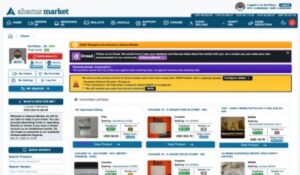
It also has its own forum with the same name for discussions between buyers and sellers. As of today, this marketplace is one of the most significant players in drugs sales in Dark Web. In addition to Empire Market’s more than 18,000 drug listings, another site called Nightmare Market now lists 28,000 drug products, along with the dark web’s usual assortment of stolen credit card numbers, counterfeits, and hacking tools. A new, Reddit-style forum site called Dread, hosted on a Tor hidden service, has already replaced the seized DeepDotWeb as a community hub, where users discuss which site to use when one is taken down by police or turns out to be run by scammers.

Tor Stuff
The Silk Road dominated the darknet until October 2013, when it was seized by the Federal Bureau of Investigation (FBI). In its wake, many more darknet marketplaces emerged (including the Silk Road 2.0), with some (e.g. Evolution and Agora) surpassing the size of the original Silk Road. In addition, from early 2014, retailers began to increasingly operate across more than one marketplace, with 10% doing so by July 2014. In November 2014, an international law enforcement operation (dubbed ‘Operation Onymous’) seized the Silk Road 2.0 along with other darknet markets and the servers on which they operated. Since this time there have been many more market disruptions that have had an impact on these markets.
Characteristics Of Suppliers
According to Europol’s 2025 Serious and Organised Crime Threat Assessment report, nearly all forms of serious and organized crime now have a digital footprint. Criminals are leveraging the online domain to increase efficiency and maintain anonymity, and darknet markets are generating US$5–7.5 million in daily revenue. The six months following Evolution’s ‘exit scam’ saw a period of great instability on the remaining darknet markets, with ever increasing ‘down time’ during which markets were not accessible. Some of this was driven by moderators trying to improve security measures and some due to ‘denial of service’ attacks.
- In Calgary, police say it’s difficult to pinpoint how many drug users are flocking to the dark net — and how much they’re buying — because the markets change constantly.
- They are encouraged to take the Russian winter weather into consideration by covering telltale footprints in the snow.
- But according to Meta, no more than 1 in 2,000 views on Facebook is of content that violates its restricted goods policy.
- The accounts of organizations promoting drug harm reduction and social media personalities who post content about drugs and psychedelics, but who do not sell them, are being caught in the crossfire of efforts to get a grip on the issue.
- Basically, any market which gets buyers what they want is best for them, isn’t it?
Publication Date
In 2024, darknet marketplaces generated over US$1.7 billion in cryptocurrency-enabled drug transactions, marking year-on-year growth of over 20%. This trend corresponds with a systematic increase in the criminal market scores relating to illicit drugs in the latest Global Organized Crime Index. These scores measure the pervasiveness and impact of various illicit economies and activities, and in 2023 all drug market indicators worsened compared to the previous iteration of the Index.
- According to Europol’s 2025 Serious and Organised Crime Threat Assessment report, nearly all forms of serious and organized crime now have a digital footprint.
- Accessing them may require .onion links and the Tor browser, but caution is advised due to legality and cybersecurity risks.
- If you happen to live far from your dealer—for me, stocking up on dope used to mean taking a Metro trip and walking through a sketchy neighborhood—this is a significant plus.
- “To me, the most surprising thing was how normal, when you set aside the goods being sold, the whole market appears to be,” he said.
- “Many people share the belief, myself included, that drugs should be legal and the dark web is that belief put into action.”
The Analysis Steps
Due to their open design, cryptomarkets have facilitated the emergence of new digital trace methods to track changes in drug markets such as the DATACRYPTO crawler maintained by David Décary-Hétu 8 and the application of large data analysis using machine learning 9. These innovations allow for early confirmation of market changes such as the emergence of fentanyl and other novel synthetic opioids 10, 11 and of new drug delivery systems, such as e-cigarette/vaping methods for drug consumption 12. These markets host hundreds, or in some cases thousands, of people who sell drugs, commonly referred to as “vendors”. The dark web offers vital anonymity for vendors and buyers, who use cryptocurrencies such as Bitcoin to process transactions.

Drugs And The Darknet: Perspectives For Enforcement, Research And Policy
Users often do not know the real identity of the fellow users they are dealing with, and it is very difficult – although not impossible – for authorities to track them. Taken together, those operations represent the most far-reaching collection of law enforcement actions against the dark web’s economy in at least two years. “You’re seeing the evolution of a coordinated law enforcement effort,” the director of Europol’s European Cybercrime Centre said. The dynamic nature of online markets, with their ability to evolve to counter threats and exploit new opportunities, means that enhanced monitoring capacity in this area is crucial to ensure that responses keep pace with developments. The analysis presented in the report is forward-looking, as the challenges in this area are constantly evolving.
Users and sellers use the cryptocurrency “Bitcoin” to complete their deals. All these conditions theoretically support the anonymity and safety of the business. The mandatory barring of leaving houses for people during the COVID-19 disaster limited the supply of drugs in Russia. We do not have monthly data on drug poisoning, but we found significant correlations with this variable in yearly data.
AI-Powered Cloud Security Platforms Set To Transform Enterprise Cyber Defense In 2025
Also, I have not verified the legitimacy/authenticity of any of these markets/vendors. Hence, if you get scammed, lose your money, or order wrong products, I (the creator/s of this article) can not be held responsible. No, black market websites operate illegally and pose high risks of scams, fraud, and law enforcement action. Some are looking for illegal stuff they can’t buy elsewhere, like drugs or counterfeit documents.
Regulatory bodies, law enforcement agencies, and private sector partners must continue to adapt, innovate, and cooperate to outpace increasingly sophisticated threat actors. Central to this effort is the use of advanced blockchain intelligence tools, which provide critical insights for tracing illicit transactions, identifying threat actors, and supporting enforcement actions. The progress made in disrupting illicit networks demonstrates the impact of collective action, but sustained vigilance and adaptability — empowered by cutting-edge blockchain analytics — will be essential to securing the crypto ecosystem in the years ahead. Despite the many challenges faced by darknet marketplaces over the course of 2024, these platforms have nevertheless seen a slight increase of income compared to 2023, generating more than USD 1.7 billion. The reduction in the quality and user numbers of Western DNMs stands in contrast to the Russian-language ecosystem, where fierce competition and high profits are driving innovation. Cryptocurrency-enabled online sales of illicit drugs saw a year-on-year growth of over 19% between 2023 and 2024, nearing USD 2.4 billion.
Therefore, they can be hypothesised to have effects on drug availability by allowing purchases by people who use drugs (PWUD) outside of face-to-face networks that have typified drug distribution. They may attract new buyers and may change use patterns by offering a greater range of higher-potency drugs. This paper examines the research on cryptomarkets’ potential impacts on drug availability. This shift poses unique challenges for law enforcement, who must adapt traditional monitoring methods. The fragmentation of darknet markets means that law enforcement agencies can no longer focus their efforts on a few large, easily identifiable targets. Instead, they must gain access to multiple, hyper-secure markets and then regularly monitor this wide array of smaller, highly localized platforms.
Though sometimes depersonalised, they are evolving and provide the basis of dealer-to-buyer direct dealing 29•. The cryptomarkets may be best seen as one part of a larger flexible social and technological structure that facilitates rapid arrangement of deals between parties and expands the range of drugs sold. Drug sellers and buyers navigate within cryptomarkets depending on the changing landscape and their specific requirements. This system generates an informal feedback loop allowing dealers to make more rapid decisions about what segments of the market to service. The use of cryptocurrency in vendor shop drug sales saw a significant surge over the past year.
Anybody who has seen All the President’s Men knows that, when it comes to criminality, the answer has always been to “follow the money”. Silk Road is just one website; bitcoin is potentially the foundation for a whole new economic order. The researcher found about 95 sellers, or four per cent, indicated they shipped from Canada during the 12-month period. Canada had the sixth-highest proportion of dealers on the site (among those who specified a location), outpacing France, Spain and China. Silk Road offered drugs, porn and fake IDs and driver’s licenses for sale. It was shut down by the FBI in 2013, but the concept had already caught on.
And according to a recent Reddit.com post, new darknet markets carry a total of 33,985 different drug deals – an almost threefold increase in darknet drug-dealing activity in just eight months. “Waste your resources on seizing petty websites because they know the use of darknet services is ever growing,” another user wrote. The drug information organization Pill Report has told of people wiring cash to dealers and getting duped, with nothing sent to them. When one such person interviewed by WIRED sent money for cannabis through a cash transfer app but received nothing in the mail, he reported the account. “It became a threatening match and they sent photos of thugs with guns saying they were going to come for me,” he says. To the UNODC, this suggests “an increase in wholesale activities” on the dark web—though this could also reflect consumers who buy smaller quantities shifting from the dark net to the clear net and encrypted messaging apps.